An access log can help you review how a release link was used, but it cannot by itself identify the person who uploaded a copy elsewhere. Start with what each record actually measures. Then decide whether to review an account, change a share or ask a member to sign in again, without treating an unusual visit as proof of a leak.
Separate an access record from evidence of redistribution
Scroll the table sideways to see all columns.
| What you can observe | What it helps you check | What it does not prove |
|---|---|---|
| A successful TierKey redirect | That a visit was allowed through that entry link. | That the file was opened, fully downloaded or reposted. |
| A failed redirect | The failure reason recorded for that visit. | That the visitor is a non-member or a pirate. |
| Repeated visits or different countries | Activity that may need review. | That one person shared an account; retries, travel and VPNs can affect it. |
| An identifying mark in a copied file | Which prepared version the copy resembles. | Who uploaded it or how that person obtained it. |
Make your release links distinguishable
Give each work or release a separate destination and a clearly named TierKey link, such as ‘October set — artwork A’. History can then show which entry link was used and, when available, the member and tier. One shared folder link cannot tell you which file inside that folder was opened.
Basic retains history for 7 days; Pro retains it for 90 days. Pro adds result filtering and member controls. Record useful observations privately within the retention period. Direct visits to a storage URL, activity before the TierKey link existed and a recipient’s local copies are outside that history.
These screenshots use the English interface. Match each number to its explanation. Select an image to enlarge it. Names, URLs and member records are examples.
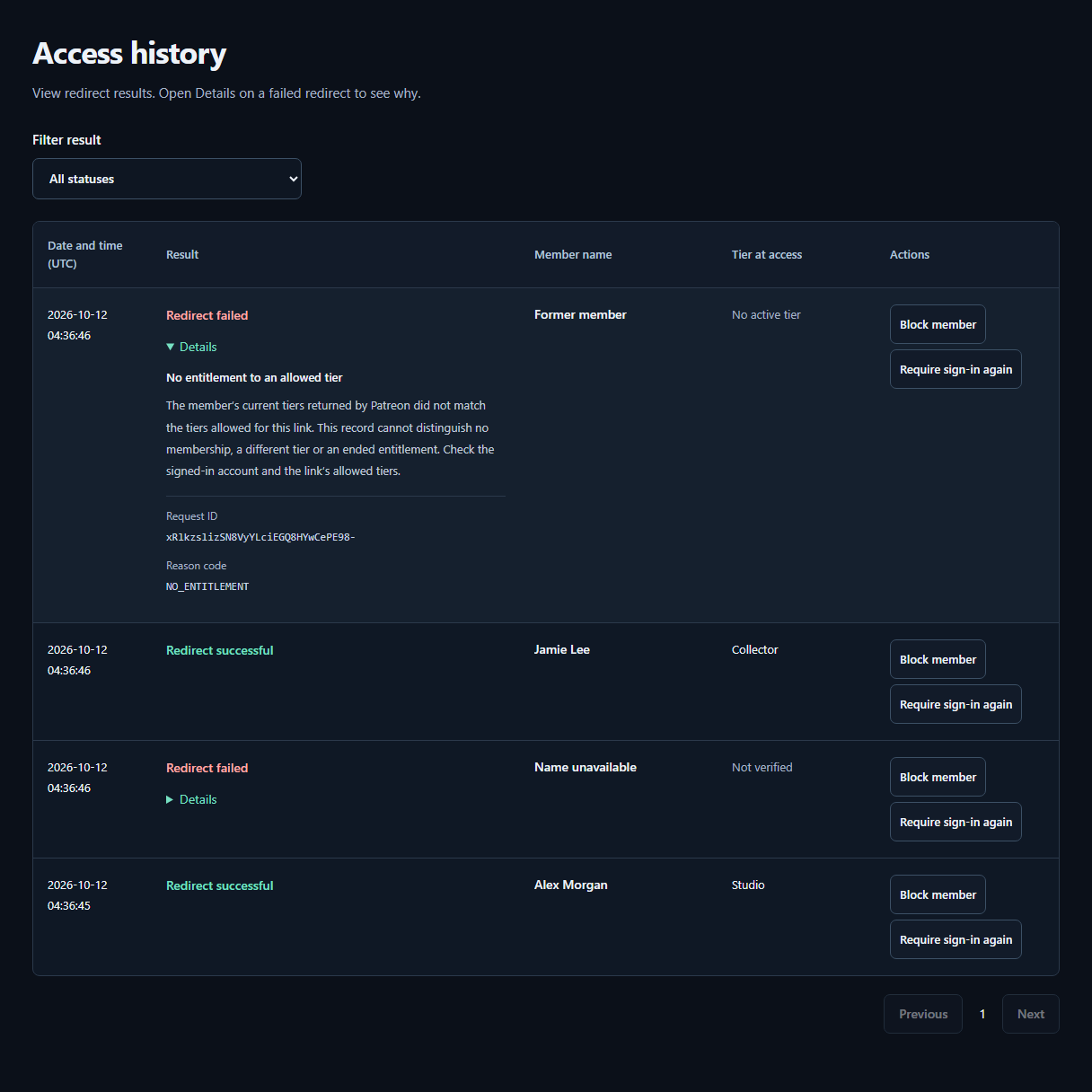
- ResultCheck whether the redirect succeeded or failed. The tier recorded at access appears beside the member’s Patreon display name.
- DetailsOpen Details on a failed row for the reason and next steps. A failure alone does not mean the visitor is not a member.
Review a suspicious pattern before acting
- Locate the relevant link and time range. Compare the release and discovery dates, but remember that the time you discovered a copy is not necessarily its upload time.
- Open failure details. An unfinished sign-in, wrong tier and temporary membership-check error need different responses; a failure alone does not establish non-membership.
- Compare multiple observations rather than choosing the first or most frequent visitor. A creator’s own tests, previews and ordinary repeat downloads can also generate activity.
- Keep any account review private. If clarification is needed, ask neutrally about access problems without publishing a name or accusing someone on timing alone.
Use watermarks as a separate distribution choice
A common creator-name watermark helps label an image but does not distinguish recipients. A different opaque code on each recipient’s version can help associate a found copy with that version if you kept an accurate private mapping. It still does not establish who later redistributed it; the version may have passed through several people.
Prepare and test marks in your own editing workflow. Adobe’s reference explains text and graphic watermarks. Check the exported file at normal viewing size and keep an unmarked master. Marks can be cropped or altered, so do not promise complete tracking.
TierKey does not add watermarks, fingerprint files or automatically issue a unique file to each member. Pro routing chooses destinations by tier, not by individual member. Any recipient-specific preparation and delivery requires a separate workflow; avoid embedding email addresses or other personal details in visible marks.
Choose a response that matches the evidence
With Pro, you can require a member to sign in again on their next visit or block their future use of your TierKey links. Keep a memo of the reason for your own records. That memo is not sent as a Patreon message, and a TierKey block does not cancel the person’s Patreon membership.
If a raw storage URL is already exposed, revoke or replace that share at the storage service. Blocking a TierKey account does not close a direct destination someone already knows. Independently uploaded copies need a separate removal process.